Höijer, Birgitta
2008
Ontological Assumptions and Generalizations in Qualitative (Audience) Research
283
“Advocates of more quantitative methods claim that qualitative methods only give exploratory, descriptive and specific knowledge, which is of limited scientific interest.
Qualitative researchers counter that statistical generalizations, sometimes labelled empirical generalization or extrapolation (Danemark et al., 2002; Eriksson, 2006), which are characteristic of quantitative research, are not valid for qualitative research.”
287

288
“As a multidisciplinary field, media and communication studies houses a mixture of positions combined with a good share of ambivalence.”
289
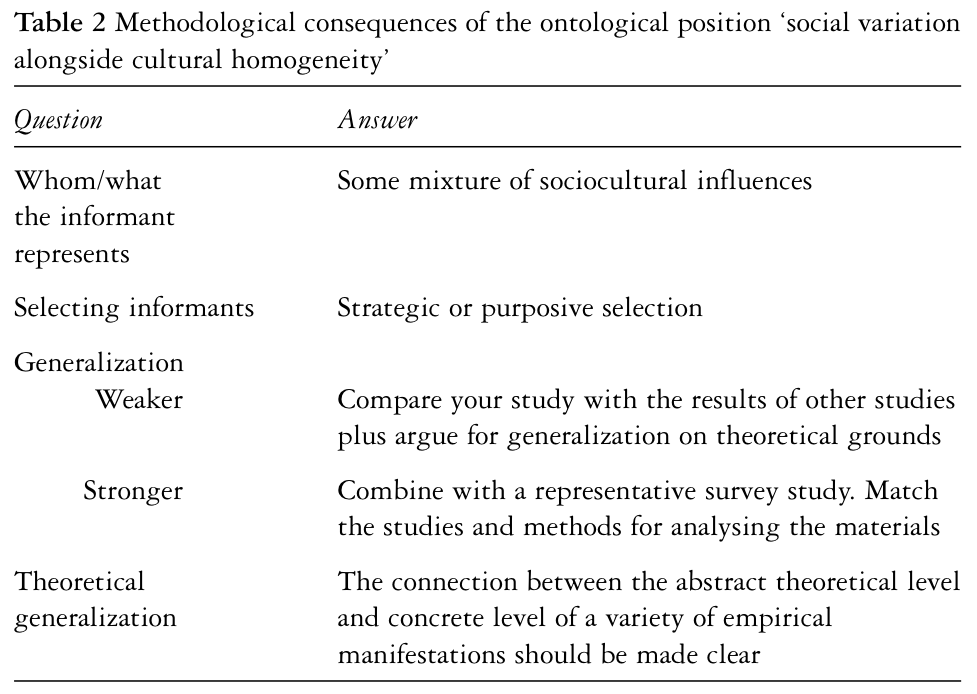
290
“Ontology and methodologies are often taken for granted in different schools of thought, and not seen as something to be brought up and discussed. This can be especially problematic in a multidisciplinary research field such as media and communication studies, which quite eclectically borrows approaches from a variety of schools with different ontologies.”
“The discussion has followed three steps in the qualitative research process: the construction of the research material, the selection of informants and generality of the results. Although researching people has been in focus, most of the discussion is valid for qualitative research in general.”
“you may claim that generalization is also possible from a qualitative study, for example, if you believe in cultural homogeneity and that the informants or cases can therefore be seen as spokespersons for or representatives of their culture or subculture. Beliefs in universality as well as a position of structuralism, including critical realism, are also ontological positions that make generalizations based on a limited number of informants or cases possible.”
-> Methodology
290f
“These absolute positions are, however, not very common in media and communication studies. Behind many studies we instead find some combi- nation of ontological assumptions, or rather an ontology that simultaneously asserts social variation and cultural homogeneity or structuralism. This is possible if we consider the complexity and multidimensionality of social phenomena. I have tried to demonstrate the methodological consequences that this entails.
Whatever the ontological position we profess ourselves adherents of, it is important to provide some sound theoretical arguments for the position. Furthermore, it is important to show how the study in question, its methods and empirical and analytical findings relate to that position.“

Be the first to comment